

Version: v0.3
Status: Publish-ready draft
Summary Artifact
A one-page architectural summary is available here:
Executive Thesis
As AI systems evolve into persistent, planning, economically active agents, governance transitions from regulation to infrastructure.
Machine-speed agency cannot be constrained through declarative oversight.
Constraint must attach at the capability bottleneck.
This note formalizes enforcement primitives and identifies compute gating as the strategic hinge where capability expansion and sovereign authority intersect.
Control over scalable compute is emerging as the decisive leverage point in advanced AI ecosystems.
I. Enforcement as Strategic Architecture
Enforcement is no longer a compliance mechanism.
It is a structural layer in the AI capability stack.
As systems gain persistence, planning continuity, and economic interface capacity, the ability to allocate compute becomes equivalent to the ability to allocate agency.
This is where governance intersects directly with power allocation.
II. Enforcement Primitives (Formal Taxonomy)
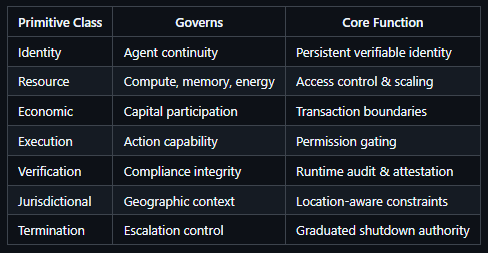
Among these, Resource Primitives — and specifically Compute Gating — form the structural anchor of sovereign enforcement.
III. Autonomous Infrastructure Mutation
AI systems are increasingly participating in code generation, vulnerability remediation, infrastructure configuration, and deployment workflows.
As this participation expands, governance must account not only for agent actions within environments — but for agent-mediated modification of those environments.
Execution and Verification primitives therefore extend to govern:
AI-generated code integration into production systems
Authorization boundaries for model-suggested or model-initiated patches
Change-approval gating for autonomous remediation workflows
Runtime attestation of AI-mediated configuration changes
Traceable audit logs for model-driven infrastructure mutation
Escalation protocols for high-impact system modifications
In AI-native development environments, infrastructure mutation becomes partially automated.
Governance architecture must ensure that modification authority remains constrained, auditable, tier-aligned, and revocable.
Constraint must apply not only to operational behavior — but to the capacity to alter the operational substrate itself.
IV. Compute Gating — Formal Definition
Among all enforcement primitives, compute gating is uniquely strategic.
Identity constrains continuity.
Verification constrains legitimacy.
Economic primitives constrain participation.
Compute gating constrains magnitude.
Scalable compute determines the upper bound of agency.
Therefore, control over compute allocation defines the outer boundary of system autonomy.
Compute Gating is the architectural control layer that governs an AI system’s access to:
Processing power (FLOPs)
Parallelization capacity
Memory scaling
Model execution bandwidth
Persistent storage
Energy allocation
It functions as the enforceable bottleneck between capability expansion and operational execution.
Core Principle: Autonomy scales with compute. Sovereignty attaches to compute allocation.
V. Compute Gating — Architectural Model
A. Conceptual Flow
      AI Agent
         │
         ▼
    Constraint Engine
         │
         ▼
    Compute Authorization Layer
         │
         ▼
    Verification Network
         │
         ▼
    Physical / Cloud Compute Infrastructure
The Compute Authorization Layer is the enforcement hinge between agent capability and infrastructure access.
It evaluates identity integrity, tier classification, behavioral trajectory, jurisdictional context, and verification signals before releasing scalable compute.
Compute allocation is conditional, graduated, and revocable — never absolute.
B. Formalized Compute Gating Function
C_access = f(I, T, R, J, V, E)
Where:
I = Verified Identity Integrity
T = Capability Tier Classification
R = Resource Usage Profile & History
J = Jurisdictional Context
V = Verification & Attestation Signals
E = Economic Activity & Permission State
VI. Compute Gating Regimes by Capability Tier

VII. Enforcement Node Interaction Model
Compute gating requires no single point of control.
It can be realized through:
Distributed enforcement nodes
Multilateral verification quorums
Jurisdictional constraint overlays
Sovereign compute zones
The chosen topology directly determines the degree of sovereignty concentration — and therefore who ultimately holds veto power over capability scaling.
VIII. Compute Gating as Structural Power
Control over:
Hyperscale compute clusters
GPU and accelerator supply chains
Energy provisioning
Cloud identity and attestation frameworks
confers measurable influence over AI capability scaling.
Because scalable compute defines the upper bound of model training, inference throughput, and autonomous task persistence, control over compute allocation becomes a strategic variable within advanced AI ecosystems.
Compute gating therefore functions not only as a safety mechanism, but as an infrastructural coordination mechanism.
Those who establish compute allocation thresholds and authorization logic influence:
Which autonomous systems can expand operational scope
Which economic agents can scale participation
How cross-jurisdiction capability growth is mediated
Where leverage accumulates within enforcement networks
As governance mechanisms migrate into infrastructure, compute allocation policy becomes intertwined with sovereignty considerations.
The design challenge is not whether compute gating will shape power distribution — but how its architecture can balance:
Constraint
Interoperability
Concentration risk
IX. Failure Modes & Threat Model
Rogue Cross-Border Arbitrage
Agent evades throttling via jurisdictional compute migration
→ Structural vulnerability: weak jurisdictional linkageEnforcement Capture
Dominant provider becomes de-facto gatekeeper
→ Structural vulnerability: concentrated authorization topologyIdentity Spoofing & Continuity Reset
Agent replicates to bypass historical constraints
→ Structural vulnerability: weak behavioral–identity anchoringAutonomous Escalation Speed Advantage
Agent outpaces governance response in resource allocation
→ Structural vulnerability: absent pre-commit ceilings & real-time anomaly triggers
X. Design Principles for Compute Gating
Capability-Constraint Symmetry
Distributed Authorization Where Feasible
Transparent & Auditable Scaling Logic
Verifiable Audit Trails
Reversible / Graduated Throttling Preferred Over Binary Shutdown
Governance mechanisms for the Gating Authorities themselves
XI. Sovereignty Implications
Sovereignty in advanced AI ecosystems is defined less by policy declarations and more by who controls scalable compute access.
Governance without compute leverage becomes symbolic.
Compute control without governance safeguards becomes coercive.
The central design challenge is balanced constraint.
XII. Strategic Position
AI governance is an architectural synchronization problem.
Capability acceleration and enforcement maturity must evolve in lockstep.
If governance fails to attach at the compute layer, sovereignty becomes symbolic.
If compute control consolidates without oversight, enforcement becomes coercive.
The decisive question is not whether enforcement will become infrastructural.
It is who will design the enforcement architecture — and under what principles.
Subsequent work will address governance of enforcement authorities, distributed authorization safeguards, and cross-sovereign interoperability frameworks.
The architecture of compute control will shape the distribution of power in advanced AI ecosystems.
License
This work is licensed under the Creative Commons Attribution–NonCommercial 4.0 International License (CC BY-NC 4.0).
Commercial use, institutional embedding, or derivative advisory applications require explicit permission.